Meaning of Passive Houses:
“Passive Houses” were defined as buildings which have an extremely small heating energy demand even in the Central European climate and therefore need no active heating. Such houses can be kept warm “passively”, solely by using the existing internal heat sources and the solar energy entering through the windows as well as by the minimal heating of incoming fresh air.
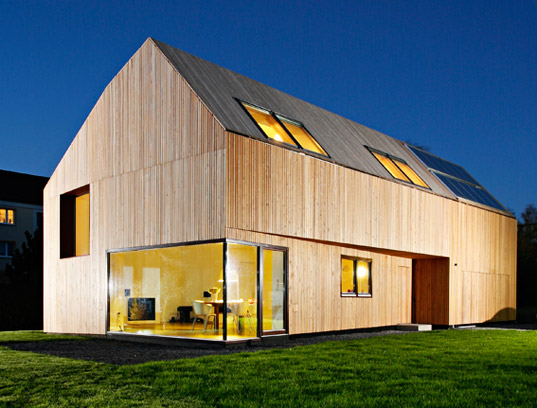
The first Passivhaus were built in Darmstadt, Germany, in 1990.
Since then, thousands of Passivhaus structures have been built, to an estimated 25,000+ as of 2010. Mainly in Europe, while in the United States there were only 13, with a few dozen more under construction. The vast majority of passive structures have been built in German-speaking countries and Scandinavia.
Passivhaus buildings employ superinsulation to significantly reduce the heat transfer through the walls, roof and floor . A wide range of thermal insulation materials can be used to provide the required low U-values, (typically in the 0.10 to 0.15 W/(m².K) range). Special attention is given to eliminating thermal bridges.
(Thermal bridge area in the building: where the heat transfer is high. Thoose places for example: corners in the buildings shape, window or door junctions, discontinued insulations in wall-floor junctions.)
Climate protection and reduced ecological footprint by Passive Houses:
When we mine coal and extract oil from the Earth’s crust, and then burn these fossil fuels for transportation, heating, cooking, electricity, and manufacturing, we are effectively moving carbon more rapidly into the atmosphere than is being removed naturally through the sedimentation of carbon, ultimately causing atmospheric carbon dioxide concentrations to increase.
Also, by clearing forests to support agriculture, we are transferring carbon from living biomass into the atmosphere (dry wood is about 50 percent carbon).
The result is that humans are adding ever-increasing amounts of extra carbon dioxide into the atmosphere. Because of this, atmospheric carbon dioxide concentrations are higher today than they have been over the last half-million years or longer.
What is Global Warming and Climate Change?
Six main greenhouse gases are carbon dioxide (CO2), methane (CH4) (which is 20 times as potent a greenhouse gas as carbon dioxide) and nitrous oxide (N2O), plus three fluorinated industrial gases: hydrofluorocarbons (HFCs), perfluorocarbons (PFCs) and sulphur hexafluoride (SF6). Water vapor is also considered a greenhouse gas.
This graph, based on the comparison of atmospheric samples contained in ice cores and more recent direct measurements, provides evidence that atmospheric CO2 has increased since the Industrial Revolution:
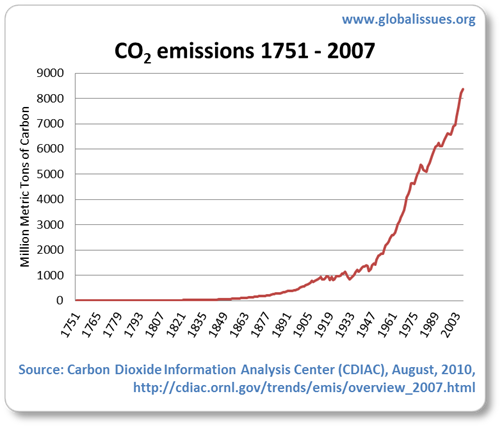
Rapidly rising greenhouse gas concentrations are driving ocean systems toward conditions not seen for millions of years, with an associated risk of fundamental and irreversible ecological transformation.

Did climate change cause Typhoon Haiyan?
Storms receive their energy from the ocean, so it would seem logical that they would get stronger, and perhaps also more frequent, as the upper layers of tropical oceans get warmer. The potential intensity of tropical storms does increase with warmer sea surface temperatures. However, the effect of warming seas could be counteracted by the apparent increase in the strength of shearing winds — winds blowing in different directions and varying in strength at different altitudes. Shearing winds tend to hinder the formation of storms, or tear them apart before they can reach extreme strength.
On balance, many climate researchers think that it is plausible that tropical-storm activity will rise as the planet warms. There is some evidence that storm intensity has increased over the last three decades, but reliable data are limited to the north Atlantic, where observations are most abundant.
Climate protection in the building sector:
"If we commit ourselves to energy conservation and climate protection, we must take an especially careful look at the great potential for energy savings in the building sector. And with the new European standard for nearly zero energy buildings, we must concern ourselves with such matters far in advance of the directive`s implementation. Good construction combines exemplary energy efficiency and building tradition, both expressed through architecture"
Dr Peter Raumser
Federal Minister of Transport, Building and Urban Development, Germany
"As Passive House can be applied to all architectural styles, focusing on construction details that can be applied in every design, it facilities the transition to the intelligent end efficient use of energy in these times of cheap overabundance. High quality, detailed solutions are now available for all construction methods as are the necessary materials. The concept can be applied to all types of construction and adapted to all building traditions."
Univ.-Prof. Dr. Wolfgang Feist
Director of the Passive House Institute
