What is a U-value?
To put it simply, U-Value is the measure of the rate at which heat is lost through a material. As it is a measure of heat loss, the lower the U-Value the better.
The U-value is the overall heat transfer coefficient that describes how well a building element conducts heat or the rate of transfer of heat (in watts) through one square metre of a structure divided by the difference in temperature across the structure.
It is expressed in watts per meter squared kelvin ( W/m²K ).
The elements are commonly assemblies of many layers of components such as those that make up walls/floors/roofs etc. It measures the rate of heat transfer through a building element over a given area under standardised conditions. The usual standard is at a temperature gradient of 24 °C (75 °F), at 50% humidity with no wind.
This means that the higher the U value the worse the thermal performance of the building envelope. A low U value usually indicates high levels of insulation.
Increasing the thickness of an insulating layer increases the thermal resistance.
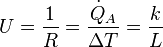
Increasing the thickness of an insulating layer increases the thermal resistance.
The external wall of a timber framed house has the following specification:
External Plaster: 15 mm thickness
Block outer leaf: 100 mm thickness
Timber stud inner leaf: 125 mm thickness
Urethane board insulation: 100 mm thickness
Plasterboard: 12.5 mm thickness
